
Why Bakuchiol Works: A Natural Approach to Smoother, Firmer Skin
A lot of people are moving toward natural products, and it feels like a breath of fresh air. When you start paying attention to ingredient labels, you realize how many things you cannot pronounce or identify. Choosing plant-based products gives you a sense of clarity. You know what you are putting on your skin, and that alone feels grounding.
But as soon as you step into the world of natural skincare, a new problem shows up. Suddenly you are seeing unfamiliar names everywhere. You are trying to do something good for your skin, and instead you are met with terms that feel scientific, trendy, or a little confusing.
Bakuchiol is one of those words that people hear and instantly wonder about. It is often called a “retinol alternative,” which sounds promising but does not answer much. What does that actually look like in real life? Is it gentler? Does it work the same way? Or is it just another natural ingredient being pushed into the spotlight?
Most people want simple answers they can trust. So let’s break down what bakuchiol is, where it comes from, and why it has become such a popular choice for people who want results without sacrificing their skin’s comfort.
Where Bakuchiol Comes From and Why It Matters
Bakuchiol originally comes from the Babchi plant (Psoralea corylifolia), a medicinal herb used for centuries in Ayurvedic and other traditional systems of medicine. The seeds and leaves of Babchi contain a compound called bakuchiol, which naturally carries antimicrobial and anti-inflammatory properties. This is part of what first drew researchers to it long before it became a buzzword in skincare.
Over time, scientists discovered that bakuchiol is a type of meroterpene with a unique chemical structure. It was first isolated from Babchi seeds in the 1960s, and by the early 1970s researchers had described its more detailed configuration. Even though those details are fascinating for chemists, what matters for the skin is that bakuchiol acts in a way that resembles retinol without actually being part of the vitamin A family.
While Babchi is the most well-known source, bakuchiol is also found in a handful of other plants. These include Japanese elm (Ulmus davidiana), long pepper (Piper longum), and several members of the legume family that grow throughout Asia and South America. Many of these plants have long histories of use for inflammatory conditions, irritated skin, and even certain types of infections.
Medicinal plants like Babchi have been used in traditional medicine for generations, either as whole-plant preparations or as purified extracts. Modern research has taken these traditional uses and begun exploring them in a more structured way. This is one reason bakuchiol has gained attention outside of skincare. Studies have looked at its potential effects on the liver, heart, bones, and even its possible antiviral and antimicrobial activity. Although these areas are still developing, they show how wide-reaching this compound may be.
For skincare, the benefit is simpler. Bakuchiol offers plant-based support that is easier for many people to tolerate. It gives users an option that feels natural while still having enough research behind it to justify the growing interest.
The Babchi Plant and Its Traditional Roots
The main source of bakuchiol is the Babchi plant (Psoralea corylifolia), a small herb that shows up in India, Pakistan, China, Southern Africa, and even parts of the southern United States. It often grows like any other weed, but its history tells a very different story. In Ayurveda it is called babchi, and in Traditional Chinese Medicine it is known as bǔ gǔ zhī. Both systems have relied on this plant for hundreds of years.
Babchi has always been closely tied to skin health. In Ayurveda it was used for concerns like psoriasis, eczema, alopecia, areas of discoloration, and inflammation. In Traditional Chinese Medicine it is seen as warming and is thought to strengthen the kidney and spleen systems. Even the plant’s Greek-derived name hints at this connection, since Psoralea comes from a word associated with itchy or irritated skin.
Modern research has confirmed that Babchi contains a wide range of active compounds.
Flavonoids, coumarins, and meroterpenes are some of the most studied groups. Bakuchiol is one of the standout compounds and was first isolated from Babchi seeds in the 1960s. That discovery helped bridge traditional knowledge with modern skincare science and eventually led to bakuchiol’s rise in beauty formulations today.
Bakuchiol and Its Wide-Ranging Properties
Bakuchiol itself is a fascinating compound. It is a meroterpene phenol with a long list of actions that researchers continue to explore. Studies have looked at its potential to support acne-prone skin, calm inflammation, reduce oxidative stress, and even influence bone health and neuroprotection. There is also growing interest in its antimicrobial properties and how it may support organs like the liver, heart, and kidneys.
This broad activity explains why bakuchiol is attracting so much attention. Traditional medicine has worked with Babchi for generations, and modern research is now confirming many of the qualities healers observed long before laboratory studies existed. Scientists have isolated bakuchiol, mapped its structure, and begun studying how it behaves in different tissues and systems.
In the skincare world, the focus is much more specific. Bakuchiol has become known as a
gentler plant-based option for supporting photoaged skin. Retinol is still the standard for
improving lines, texture, and clarity, but it can be harsh. Many people cannot tolerate the
dryness and irritation that come with traditional retinoids. Bakuchiol steps into this space as a more comfortable option. Early research shows that it can support collagen pathways and offer visible improvements while being much easier on the skin barrier.
The research is still young compared to retinol, but the combination of traditional use, broad biological activity, and early clinical findings has put bakuchiol on the map as a natural ingredient worth paying attention to.
Bakuchiol vs Retinol: What You Actually Need to Know
How They Work in the Skin:
Retinol has been the standard in skincare for a long time because it helps with lines, texture, and visible signs of aging. It supports collagen, strengthens the deeper layers of the skin, and encourages renewal. These are the reasons so many dermatologists recommend it, but they are also the reasons some people struggle with it. When the skin is pushed too quickly, it can become dry, flaky, or irritated, especially for anyone with a sensitive barrier.
Bakuchiol offers a different way in. Even though it does not belong to the vitamin A family, research shows that it can engage many of the same pathways that give retinol its power. Both ingredients have been shown to support genes connected to firmness, hydration, and overall structure. This includes different types of collagen and proteins like aquaporin 3, which helps the skin hold on to water. In one study, bakuchiol even increased aquaporin 3 expression more strongly than retinol.
This does not make bakuchiol a duplicate of retinol, but it tells us that the skin recognizes it in a meaningful way.
What the Research Shows in Real Life
Clinical studies help bring the picture together. In a twelve week trial with women between 40 and 65 years old, bakuchiol led to steady improvements in wrinkles, roughness, firmness, brightness, and overall appearance. The longer they used it, the better the results were. What stood out was how well people tolerated it. The usual dryness and peeling that comes with retinol were noticeably less common.
A direct comparison study tested bakuchiol and retinol side by side in a double-blind design. Both groups saw improvements in pigmentation and wrinkles, which shows that bakuchiol can hold its own. The difference came down to comfort. The retinol group reported more scaling and burning at every check-in. The bakuchiol group had a bit of redness early on, but overall it was far easier for people to continue using.
There is also promising research for people with sensitive skin. In one study that included
participants with eczema, rosacea, and general skin reactivity, a bakuchiol-based routine
improved smoothness, clarity, brightness, and overall appearance without disrupting the skin barrier. Moisture levels increased and water loss stayed stable, which is exactly what we want to see in sensitive skin. A few participants experienced mild stinging or tightness, but these reactions were minimal.
Some studies have tested bakuchiol in formulas that combine it with antioxidants like vitamin C and melatonin. These combinations also showed improvements in texture, radiance, and hydration. This tells us that bakuchiol plays well with other supportive ingredients and can fit into a routine that focuses on nourishment rather than aggression.
In simple terms, bakuchiol offers many of the visible benefits associated with retinol, but in a way that feels more comfortable for most skin types. It supports collagen, helps with tone and texture, and encourages gradual, steady improvements. For anyone who has tried retinol and found it too harsh, bakuchiol is a thoughtful alternative that respects the skin while still delivering results.
Bakuchiol has earned its place in modern skincare because it gives people a way to care for their skin without overwhelming it. It supports collagen, improves texture, and encourages a healthy glow in a way that feels steady and sustainable. For anyone who wants the benefits of a retinol-style product but needs something gentler, bakuchiol offers a clear path forward.
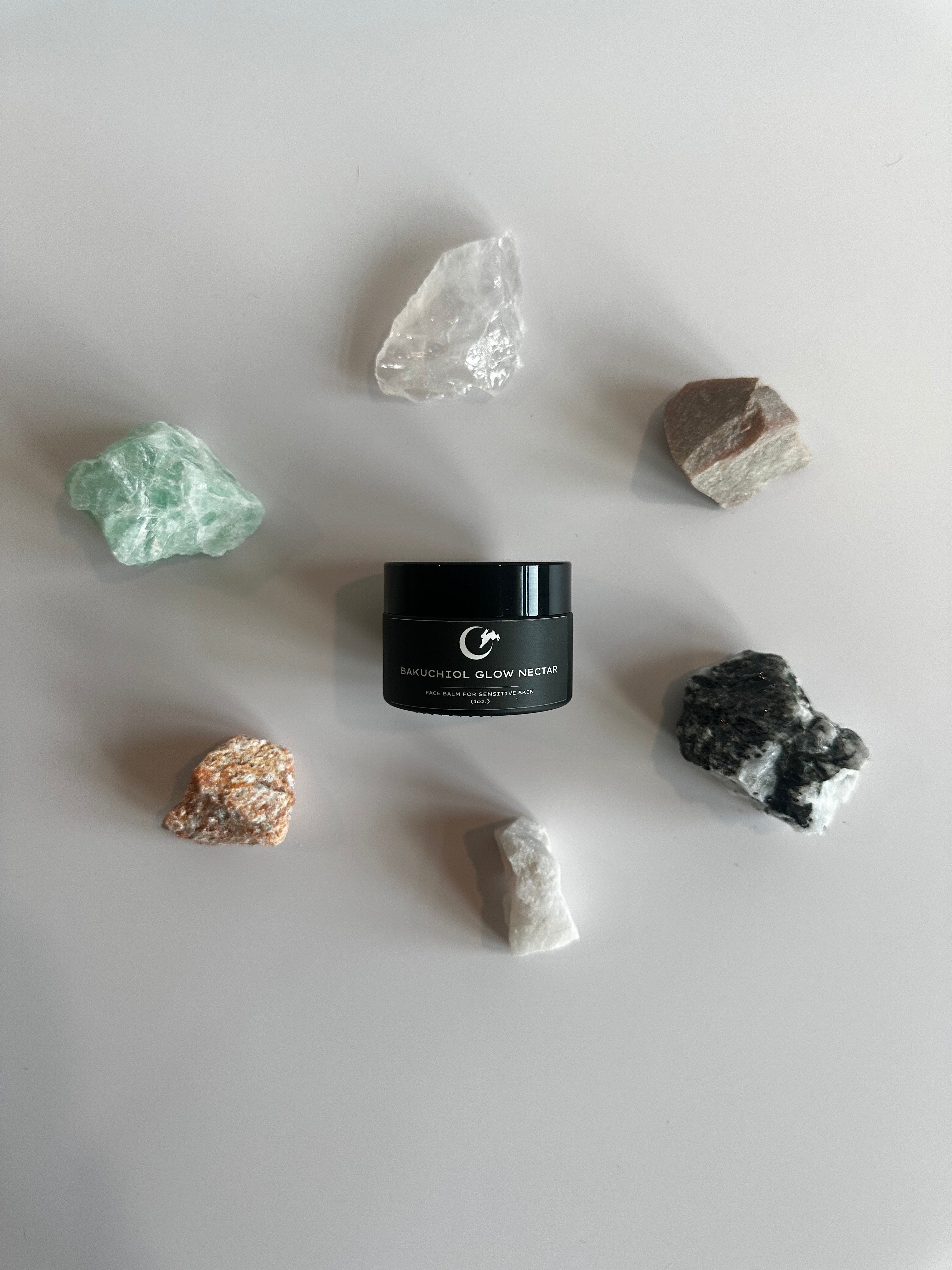
If you are curious about trying bakuchiol in a way that feels nourishing rather than aggressive, the Bakuchiol Glow Nectar is a beautiful example of how this ingredient can shine when it is supported by thoughtful formulation. It blends bakuchiol with watermelon seed oil, cupuacu butter, blueberry seed oil, and rosehip seed extract to create a balm-to-serum that melts into thenskin and brings a real sense of comfort. It smooths, firms, and brightens without the dryness that often comes with traditional retinol, which makes it a lovely option for sensitive, mature, or dry skin.
Skincare works best when it feels good to use, and bakuchiol gives you a way to support your skin with consistency and ease. Whether you are rebuilding your barrier, looking for a gentler alternative to retinol, or simply wanting to bring more radiance into your routine, bakuchiol is a plant-based ally worth exploring.
– Agy | The Buffalo Herbalist
thebuffaloherbalist.substack.com
Bibliography
Chaudhuri, R. K., & Bojanowski, K. (2014). Bakuchiol: a retinol‐like functional compound revealed by gene expression profiling and clinically proven to
have anti‐aging effects. International Journal of Cosmetic Science, 36(3), 221–230.
https://doi.org/10.1111/ics.12117
Nizam, N. N., Mahmud, S., Ark, S. M. A., Kamruzzaman, M., & Hasan, M. K.
(2023). Bakuchiol, a natural constituent and its pharmacological
benefits. F1000Research, 12, 29. https://doi.org/10.12688/f1000research.129072.2
“A comprehensive review of topical bakuchiol for the treatment of photoaging: Retinol
use may be limited by cutaneous side effects and concerns of teratogenicity. Bakuchiol
may be a promising natural alternative to topical retinol in terms of efficacy and safety”.,
JOID, vol. 1, no. 1, Sep. 2022, doi: 10.64550/joid.9jag0x17.

Leave a comment
This site is protected by hCaptcha and the hCaptcha Privacy Policy and Terms of Service apply.